Manchester decoder
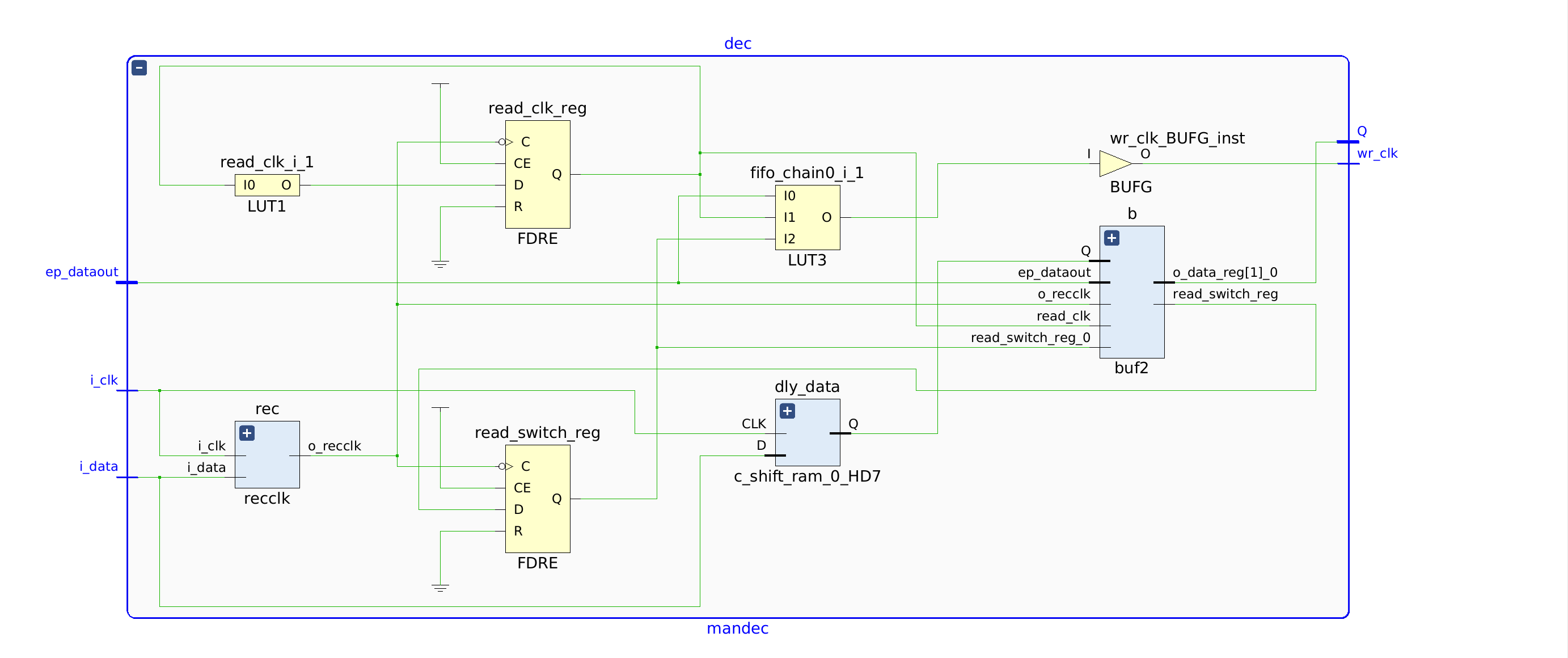
mandec (hdl/source/design/mandec/mandec.v) recovers a clock from the
Manchester signal and emits decoded bits. Both channels instantiate it
identically; only the input pin differs.
Clock recovery
The circuit follows US5245635A.
dly_data delays the input by a fixed number of 400 MHz genClk ticks, and the
XOR of the input with its delayed copy marks every transition:
assign o_clk = ~i_reset | (read_clk ^ read_switch);
The delay must be a quarter of the bit period — half a chip. It is set by
the Depth of the c_shift_ram_0 IP, shared by both decoders:
$$\text{rate (MHz)} = \frac{100}{\text{Depth}}$$
Each recovered edge produces two samples per bit (before and after the mid-bit
transition). Those land in a 2-bit buffer buf2, and the output clock is masked
so it toggles once per bit and only when the pair is not 00 or 11 — a
Manchester violation. That masking is the decoder's built-in error check.
The recovered clock stops when the input goes idle
read_switch updates only on a 00/11 symbol, and it updates so as to
cancel the XOR. With a static input the recovered clock does not free-run —
it stops. That is inherent to the circuit, not a fault, but every FIFO
clocked by it stops too, which is why those FIFOs need a sequenced reset —
see The FIFO reset sequencer.
Manchester convention
The two conventions differ in which half of the chip pair carries the bit:
| Convention | Recovered bit | 01 → |
10 → |
|---|---|---|---|
normal |
pair[1] |
0 | 1 |
| IEEE | pair[0] |
1 | 0 |
They produce inverted data from the same signal. Picking the wrong one does not look like inversion — it looks like the preamble is missing and the stream is corrupt.
Selected once for both channels by a localparam in USBInterface.v:
localparam MANCHESTER_IEEE = 1'b1; // 1 = IEEE, matches the current transmitters
All bitfiles in this repo are IEEE, which is what the miniscope transmitters
use. Bitfile names carry the convention (...-IEEE.bit).
Changing the rate
Rate applies to both channels — one c_shift_ram_0 feeds both decoders.
| Rate | Depth | Rate | Depth | |
|---|---|---|---|---|
| 8.33 MHz | 12 | 20 MHz | 5 | |
| 10 MHz | 10 | 25 MHz | 4 | |
| 12.5 MHz | 8 | 33.33 MHz | 3 | |
| 14.29 MHz | 7 | 50 MHz | 2 | |
| 16.67 MHz | 6 |
Not every rate is reachable, since Depth is an integer. Use
build_bitfile.tcl rather than editing the IP by hand —
it forces the IP to regenerate, which a manual edit does not always do.
Tolerance to an off-nominal transmitter shrinks as the rate goes up, and it is asymmetric: a transmitter running fast breaks decoding before one running slow.